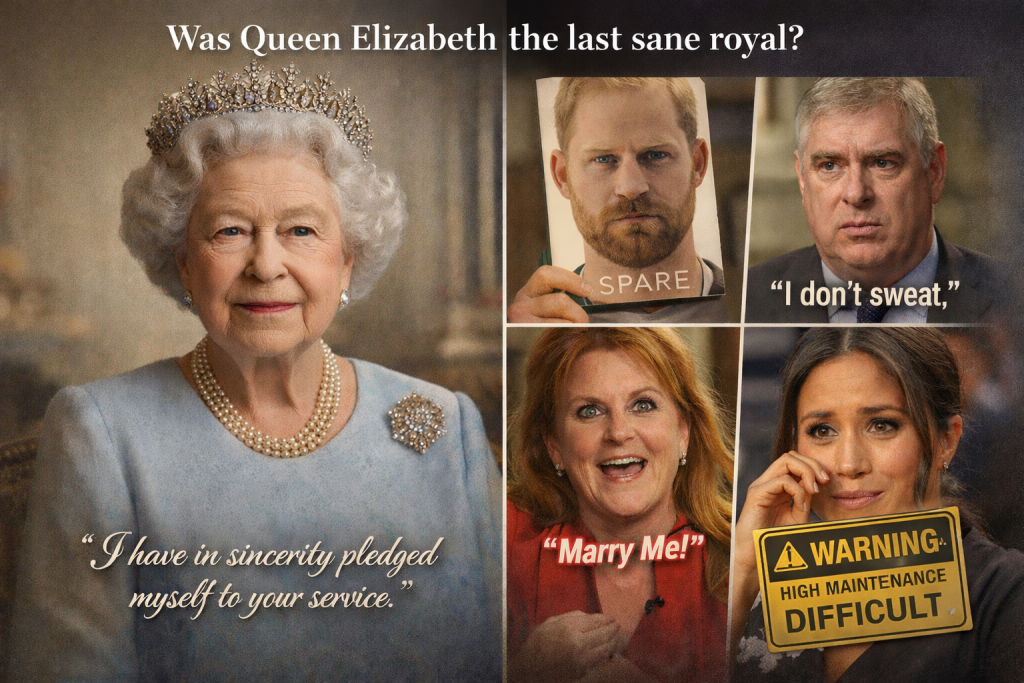
There is a question that has been quietly forming in the public’s mind since the death of Queen Elizabeth II. It is not really about monarchy versus republic, nor tradition versus modernity. It is simpler and more unsettling than that. Was Queen Elizabeth the last sane royal the House of Windsor produced? By sanity we do not mean kindness or modern values. We mean a sense of limits, a willingness to hold back, and an understanding that public service is not theatre and privilege only endures when it stops demanding attention.
Queen Elizabeth understood that instinctively. She did not attempt to be relatable. She did not explain herself. She did not share her inner life, monetise her experiences, or invite the public to feel sorry for her. She turned up, said little, and carried the weight of the role without demanding recognition for doing so.
That instinct was shaped by experience. During the war she trained as a mechanic and ambulance driver, not because she had to, but because she believed it mattered. Her husband Prince Philip served in the navy, saw combat, and ended the war as a senior officer. He was frequently in trouble later in life for old fashioned remarks that clashed with a changing culture, but he remained oddly likeable because they were delivered without self pity or grievance. He never claimed injury, never demanded sympathy, and never pretended the world owed him understanding.
Between them they shared a worldview that now feels almost extinct. When life is serious, you stop talking and get on with it. No image captured that mindset more clearly than the sight of Queen Elizabeth sitting alone in St George’s Chapel at Prince Philip’s funeral during the pandemic, masked and silent, observing the same rules as everyone else while the country watched from their living rooms. It was not staged, explained, or commented on. It simply happened, and it said everything.
For seventy years Queen Elizabeth acted as a stabilising force not through charisma or innovation, but through silence. She absorbed crises rather than amplifying them. She did not modernise the monarchy by emotional confession. She embodied the bargain at the heart of it. Extraordinary privilege in exchange for personal restraint. What followed her reign has been less a transition than an exposure.
Prince Andrew represents the most glaring collapse of judgement. His long association with Jeffrey Epstein, and his inability to account for it convincingly, dragged the monarchy into territory from which there is no dignified retreat. Faced with civil action brought by Virginia Giuffre, he chose neither to defend himself fully in court, nor to accept responsibility, but instead to pay a substantial settlement while insisting he admitted no guilt. It was an attempt to make the problem disappear without ever confronting it, a luxury afforded only to those accustomed to insulation from consequence. The now infamous interview was not simply a public relations disaster, but a moment in which a man appeared genuinely unable to understand how his words sounded outside his own head.
Sarah Ferguson has followed a parallel but noisier path. Long entangled in the Epstein scandal herself, photographed and questioned about the relationship, she has spent years oscillating between contrition, reinvention, and self promotion. Her recent public “marry me” remarks, delivered with a breathless sincerity more suited to reality television than public life, crystallised the problem. Today, even her charitable work has collapsed, with her foundation announcing its closure amid mounting reputational strain. Charities survive on trust, and trust evaporates when the figurehead cannot stop talking.
The family has seen this pattern before. Princess Margaret was an early warning that went largely ignored. Glamorous, restless, often drunk, and deeply frustrated by the constraints of her role, she embodied what happens when personality and position are fundamentally mismatched. Her life was not scandalous so much as tragic, privilege without purpose slowly turning inward.
Princess Anne sits elsewhere. Abrasive, bossy, and openly uninterested in charm, she has little concern for public affection. Yet she works relentlessly, avoids self mythologising, and treats duty as a job rather than a platform. She is not warm, but she is grounded, which in this family now counts as an achievement.
Then there is Prince Harry, whose story has become a single, continuous arc of grievance. What began as a decision to leave the institution hardened into a lucrative campaign to publicly prosecute family resentment, delivered through interviews, documentaries, speeches, and finally a memoir that reduced a life of immense privilege to a catalogue of slights and imagined betrayals. Spare was not courageous or revelatory, but small, obsessively focused on childhood grievances, sibling rivalry, and perceived injustice, all offered with the expectation that exposure would be mistaken for moral authority. The personal cost has been severe. Harry now appears unable to return home, unable to hold a private conversation with his own family, and trapped in a role where escalation is the only remaining currency.
Alongside him stands Meghan Markle, whose instincts are shaped by celebrity culture rather than constitutional restraint. Narrative control, emotional visibility, and personal validation sit at the centre of her approach to public life. Whatever one thinks of her treatment by the media, the attempt to impose a Hollywood logic of self expression and therapeutic disclosure onto an institution that survives only through silence was always destined to fail. The monarchy does not reward authenticity. It rewards containment.
Against this backdrop, the question almost answers itself. Yes, Queen Elizabeth probably was the last sane royal, if sanity is defined as proportion, restraint, and an understanding of limits.
And yet there is a narrow path forward.
Prince William and Catherine matter not because they are inspiring, but because they are dull in precisely the right way. A former rescue and air ambulance pilot, and a woman who endured years of scrutiny and serious illness without turning either into content, they do not explain themselves or perform vulnerability. They resemble Queen Elizabeth not in personality, but in instinct.
Say less. Appear less. Endure more.
Whether that will be enough is unclear. Institutions rarely recover once they begin talking too much. But if the monarchy avoids collapsing entirely into celebrity farce, it will not be because it reinvented itself or learned to share its truth. It will be because a small number of people remembered the lesson Queen Elizabeth lived by.
Fewer words. Fewer interviews. Far fewer feelings.